

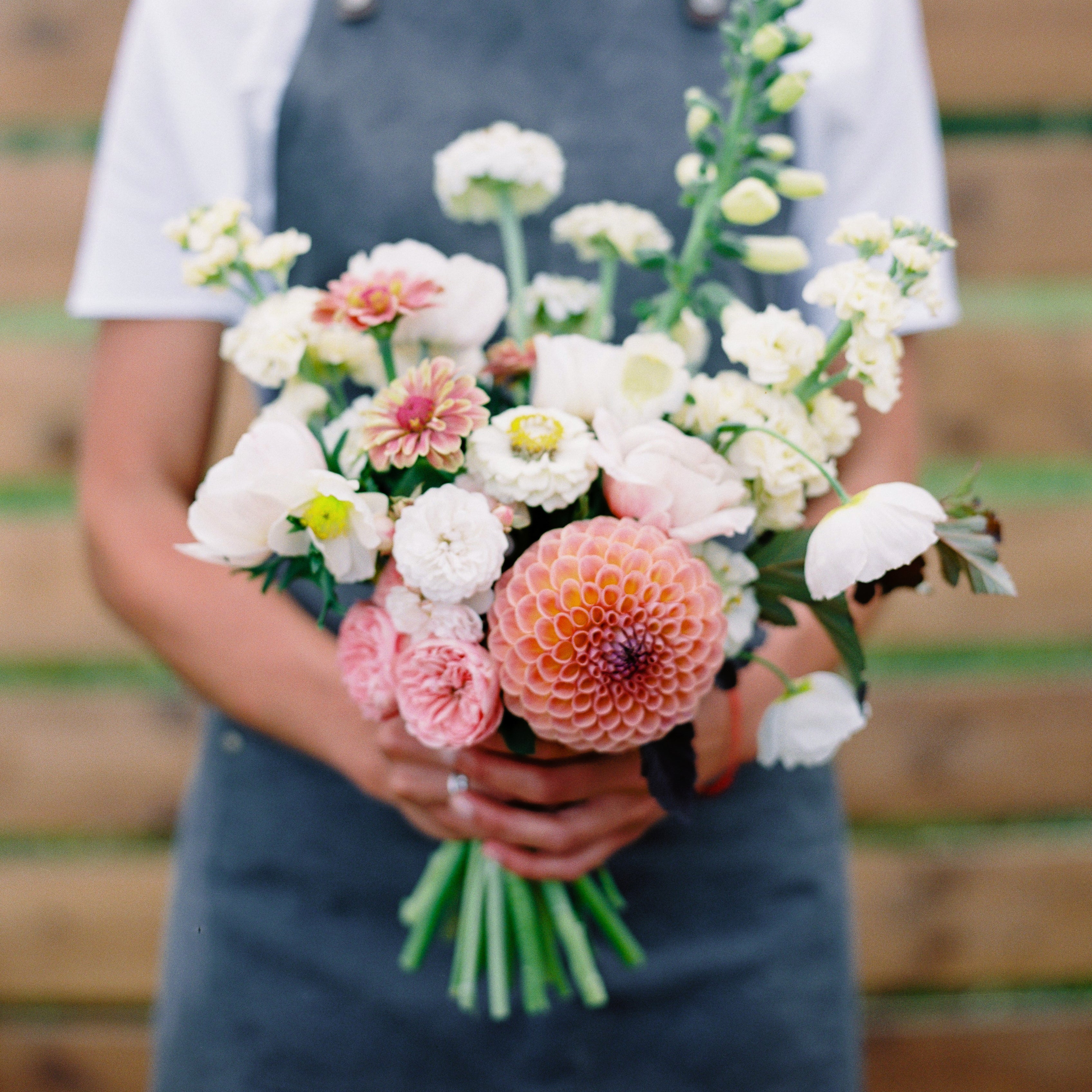
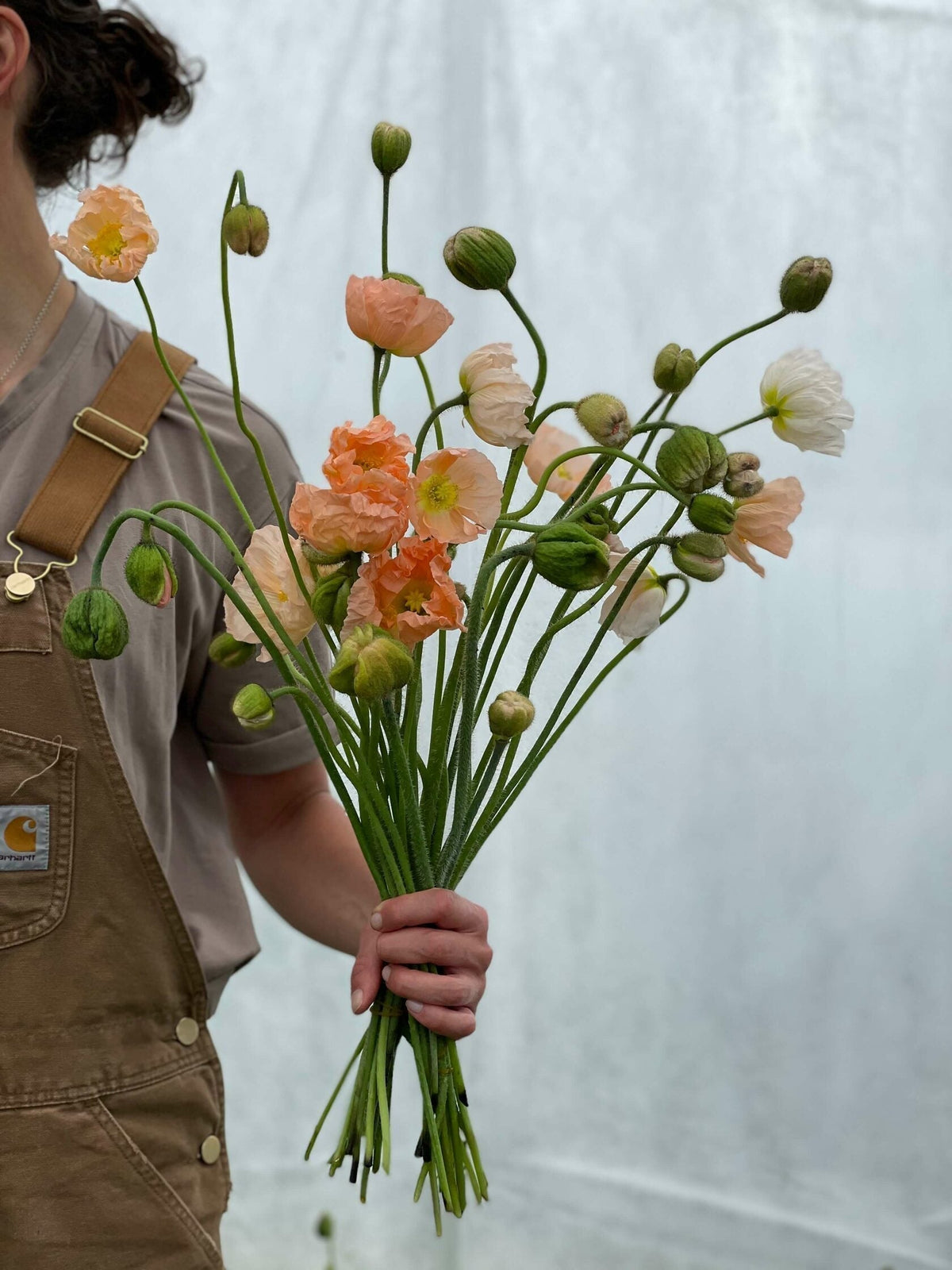
From the very beginning of our journey as flower farmers, Iceland poppies have won us over with their delicate beauty. Their soft petals are like a dress made of crinkled silk slowly unfolding—romantic, delicate, and full of charm.
Papaver nudicaule
Iceland poppy, or the Arctic poppy, Papaver nudicaule, is a species in the poppy family. There are also other poppy species grown by gardeners for their ornamental value, including the common poppy (Papaver rhoeas) and the Oriental poppy (Papaver orientale).

Iceland poppies are a delicate and demanding crop. Their seeds are very small, and growing strong seedlings requires some skill. Iceland poppies do not tolerate heat well and can be quite susceptible to pests and diseases.
They are also difficult to overwinter in the climate of Scandinavia and Eastern Europe, where winters can be frosty, with temperatures below -10°C for extended periods. In these regions, they are best grown as an annual crop. In UK, Western and Southern Europe, they can be grown as a biennial. In these regions, seeds can be sown in September, and the plants can overwinter well without any protection (or low tunnels if required) producing abundant flowers in spring.
Iceland poppies are not a crop for beginner gardeners.
We grow Iceland poppies in a glass greenhouse, which we additionally insulate with non-woven fabric. We plant out young poppy plants there in mid-November, giving them enough time to establish well and produce flowers in March and April.

Growing seedlings
We sow Iceland poppies from mid till end of September. It is very important that the seedlings are no more than 8–10 weeks old when they are planted out. If the seedlings are kept too long and planting is delayed, their growth and development can slow down significantly.
Iceland poppies do not tolerate transplanting well, so we plant the seedlings directly from their trays into the ground, taking care not to damage their delicate roots.

Cutting
Iceland poppies can last up to 7–10 days in a vase if they are cut and conditioned properly. Cut them at the right stage, just as the bud starts to split and the petals begin to show color. Then sear the stems over an open flame for 5–7 seconds (see the second photo below). This helps prevent the milky sap from clogging the stems and blocking water uptake.
Immediately place the stems in a clean container filled with fresh, cold water. If you follow these steps, your Iceland poppies will stay beautiful in the vase for a long time.


We have grown around 20 varieties of Iceland poppies from both Italian and English series. The flowers from the English series are smaller and more delicate, so we choose the Italian Colibri series for our own production.
The Italian Colibri series produces larger flowers, has a longer vase life, and comes in a beautiful range of colors. For that beauty alone, they are definitely worth growing!



1 Kommentar
Behnam Khosravan
Order 3499
Complaint about quantity of Iceland Poppy seeds
Dear FluffyFlower,
I ordered Iceland Poppy seeds from you. According to the packaging/product information, I expected approximately 50 seeds.
However, while sowing them, I noticed that the actual quantity was much smaller. I sowed the seeds directly in the ground and, while distributing them, I counted only around 15 seeds/pieces, certainly far fewer than 50.
Unfortunately, I did not take any photos, as I only noticed the shortage during and after sowing.
I would appreciate it if you could let me know how this can be resolved. A replacement packet with the correct quantity of seeds would be perfectly fine for me.
Hinterlasse einen Kommentar
Diese Website ist durch hCaptcha geschützt und es gelten die allgemeinen Geschäftsbedingungen und Datenschutzbestimmungen von hCaptcha.