


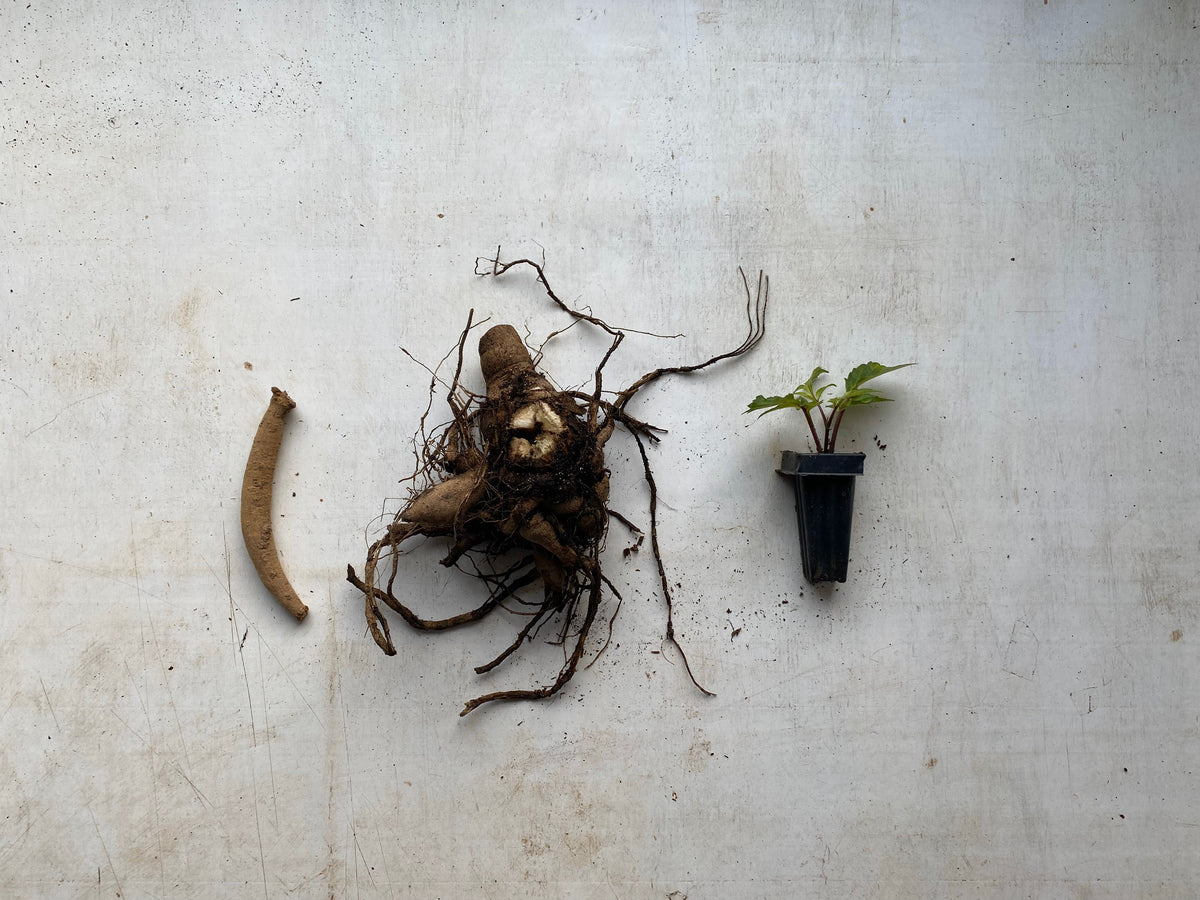
Our dahlia collection includes dahlia tuber divisions, dahlia tuber clumps and rooted cuttings. So, which planting unit should you choose, and what is the difference between them?
Why aren't dahlias propagated from seed?
When it comes to preserving a named dahlia variety, seeds are not the way to produce identical plants. Dahlias have complex genetics, and seedlings generally do not retain all the characteristics of their parent plants. Instead, vegetative propagation is used to produce genetically identical copies, or clones, of a selected variety. This can be done using tuber divisions and cuttings.
It is fascinating to think that all plants of KA’s Cinder Rose, one of the most sought-after dahlia varieties introduced in 2024, originated from a single seedling grown in 2021 by American dahlia breeder Kristine Albrecht. That original seedling was assigned the breeding code 21-2041-01.
The variety was subsequently propagated and distributed worldwide through tuber division and cuttings. This is how named dahlia varieties are preserved and shared among growers.


What types of dahlia planting material are available?
There are 3 main types:
Dahlia Rooted Cuttings
Dahlia Tuber Divisions
Dahlia Tuber Clumps.
1. Dahlia Rooted Cuttings
Some dahlia varieties, particularly rare and highly sought-after, are available only as rooted cuttings. If you have your eye on a particular variety, a cutting may be the only way to obtain it.
Why are rare varieties often sold as cuttings?
Cuttings are one of the fastest ways to propagate dahlias. Dahlias root readily from cuttings, allowing growers to produce new plants without having to wait an entire growing season for new tubers to develop.
For Dutch commercial growers, cuttings are essentially the starting material for tuber production. Cuttings are planted outdoors, where they develop their root systems throughout the growing season and form tubers by autumn. These tubers can then be harvested and sold as planting material.
A single tuber can produce between 20 and 40 cuttings, depending on the variety. Some cultivars can produce as many as 70 cuttings, while others may yield only 5–10.
Advantages
1. Carefully selected mother plants. The mother plants used for cutting production originate from tuber clumps inspected for signs of disease. At Fluffy Flower, we also select plants for vigour, flowering performance and varietal identity.
2. Faster establishment and earlier flowering. Rooted cuttings are actively growing plants with established root systems. They can resume growth without first breaking dormancy, potentially resulting in earlier flowering than plants grown from dormant tubers or tuber divisions planted at the same time.
3. Uniform growth and flowering. Cuttings are genetically identical to their mother plants. When grown under comparable conditions, they tend to show greater uniformity in growth habit, vigour and flowering time.
4. Reliable varietal identity. At Fluffy Flower, mother plants are carefully selected, labelled and tracked throughout propagation. This helps us maintain varietal identity and minimize the risk of mix-ups.
Disadvantages
1. Acclimatization after delivery. Rooted cuttings are actively growing plants and can be sensitive to changes in temperature, humidity and light during transportation. After unpacking, they need time to adjust to their new environment. Please follow our acclimatisation instructions carefully to minimise stress and encourage healthy growth.
2. More expensive and time-sensitive delivery. Unlike dormant tubers, rooted cuttings require faster delivery because prolonged transit can compromise their condition. We aim to limit shipping time to approximately 3–5 days, which can make delivery more expensive and restrict the available shipping options.


2. Dahlia Tuber Divisions
A dahlia tuber division is a section of a mature tuber clump containing at least one viable growing point, or eye. Our tuber divisions are grown at our Dutch farm.
Advantages
1. Adaptation to local growing conditions. These divisions are grown in the Netherlands, where they develop under the local climate and soil conditions. This can make them a suitable choice for gardeners growing dahlias in similar environments.
2. Established planting material. Mature tuber divisions have developed through a full growing season and can provide a good start when planted under suitable conditions. However, their health depends on the condition of the original plant and the growing and storage practices used.
3. Reliable flowering in the first year. Dahlia tuber divisions will generally flower during their first growing season when planted and cared for correctly, although flowering time and abundance depend on the cultivar and growing conditions.
Disadvantages
1. Limited availability. Each tuber clump must be divided by hand, which limits the number of divisions available.
2. Careful storage is essential. Before planting, divisions must be stored under appropriate conditions to prevent them from drying out or rotting.


3. Dahlia Tuber Clumps
Our Dutch-grown tuber clumps are produced from cuttings taken from mother plants. The cuttings are planted outdoors in May-June and lifted in late autumn, by which time they have developed tubers.
Advantages
1. Availability and price. Some varieties are commercially produced in the Netherlands which allows larger quantities to be supplied, making Dutch-grown planting material a practical choice for gardeners who want to grow multiple dahlias.
2. Potential for division. Some cultivars produce sufficiently large tuber clumps that can be divided before planting. Depending on the variety and the size and structure of the planting material, one clump may yield several viable divisions. For example, Pink Pearl and Sweet Nathalie may produce up to five divisions from a sufficiently large clump.
3. Potential for improved plant health. Mother plants can be selected and tested, and propagation through cuttings can help reduce the risk of carrying over certain problems associated with the original tuber. However, the health status of the planting material ultimately depends on the health of the mother plants and the propagation and testing practices used.
Disadvantages
1. Storage sensitivity. Tubers clumps can dry out or rot if stored incorrectly. Their condition depends on the size and structure of the tubers, the storage environment and the cultivar.
2. Adjustment to new growing conditions. Depending on the variety and growing environment, plants may need time to establish themselves in a different climate or soil.


How should you choose?
Dahlia rooted cuttings are young, rooted plants ready to grow. They can flower during the same growing season as dahlias grown from tubers or tuber divisions, provided they are planted at the appropriate time and receive suitable growing conditions.
Unlike dormant tubers, rooted cuttings do not need to be started into growth in advance. After transportation, however, they benefit from a short acclimatization period before planting.
During the growing season, cuttings develop their own tuber tuber clumps, which can be lifted, stored and divided in subsequent years. We provide detailed instructions on acclimatization and recommendations for growing strong, well-developed tubers.
At Fluffy Flower, we carefully select our mother plants for varietal identity, vigour and abundant flowering. We also inspect them for visible signs of bacterial and viral disease. Please note that an absence of visible symptoms alone does not guarantee that a plant is free from viruses.
If you value planting material grown under local conditions and want to establish plants from mature tuber divisions, tuber divisions may be the right choice.
If you are looking for a more economical option and would like the possibility of obtaining two to five planting units from a sufficiently large tuber clump, consider Dutch-grown tuber clumps. The number of viable divisions will depend on the cultivar and the size and condition of the clump.

Laat een reactie achter
Deze site wordt beschermd door hCaptcha en het privacybeleid en de servicevoorwaarden van hCaptcha zijn van toepassing.