

When you look at a beautiful dahlia, it is easy to think only about the flower itself - its color, form, size and stem. But behind every named dahlia is a story of genetics, selection, patience and, very often, thousands of seedlings that never become a variety.
Few modern dahlia breeders illustrate this better than Kristine Albrecht, the founder of Santa Cruz Dahlias in California. For almost two decades, Kristine has devoted her small urban farm to one thing above all else: creating new dahlias.
Her cultivars, all carrying the KA’s® prefix, have become well known among flower farmers, florists, designers and dahlia exhibitors. But what makes her work especially interesting is that she does not breed only for the show bench. She looks for flowers that are beautiful in the hands of a florist as well as under the critical eye of a dahlia judge.

From giant pumpkins to dahlias
Kristine's story with dahlias began in an unexpected way. Before becoming a dahlia hybridizer, she and her son grew giant pumpkins. Their largest pumpkin reached an impressive 875 pounds. But when her son eventually lost interest in growing them, Kristine was looking for another plant project.
The family owned a neglected quarter-acre piece of land in a suburban part of Santa Cruz, California. The land was overgrown and covered with weeds. In 2006, Kristine decided to reclaim it. She started with around 500 dahlia tubers.
What began as a personal gardening project quickly developed into a cut flower farm. She joined the Monterey Bay dahlia society to learn more about dahlias. But growing dahlias was only the beginning. Kristine became increasingly fascinated by the possibility of creating dahlias that did not yet exist.

A quarter acre dedicated to breeding
Today, the same small piece of land is home to an extraordinary breeding program. Kristine has worked on her quarter-acre farm for almost two decades and her breeding program produces around 1,500 seedlings in a season, from which only a small fraction are selected to continue. That selection process is one of the hardest parts of breeding.
A dahlia grown from seed is genetically unique. Seeds produced by the same seed head can develop into flowers with completely different colors, forms and plant characteristics. Kristine has described the process as being rather like having a litter of puppies: you never know exactly what each seed will become. And most seedlings simply do not make the cut.
Some have poor stems. Some have weak plants. Some have colors that are not interesting. Some are beautiful but too similar to varieties that already exist. Others may have an attractive flower but fail as a cut flower or do not meet exhibition standards. The breeder's job is not simply to find beautiful flowers.
It is to decide which beautiful flowers are worth reproducing.


Breeding for florists - and for the show bench
One of the things that distinguishes Kristine's work is the balance between two very different worlds - dahlia exhibitions and florists. Dahlia exhibitions have extremely precise standards. Judges evaluate flower form, symmetry, color, condition and many other details. But a florist may want something completely different.
A flower can be imperfect according to exhibition standards and still be extraordinary in an arrangement.
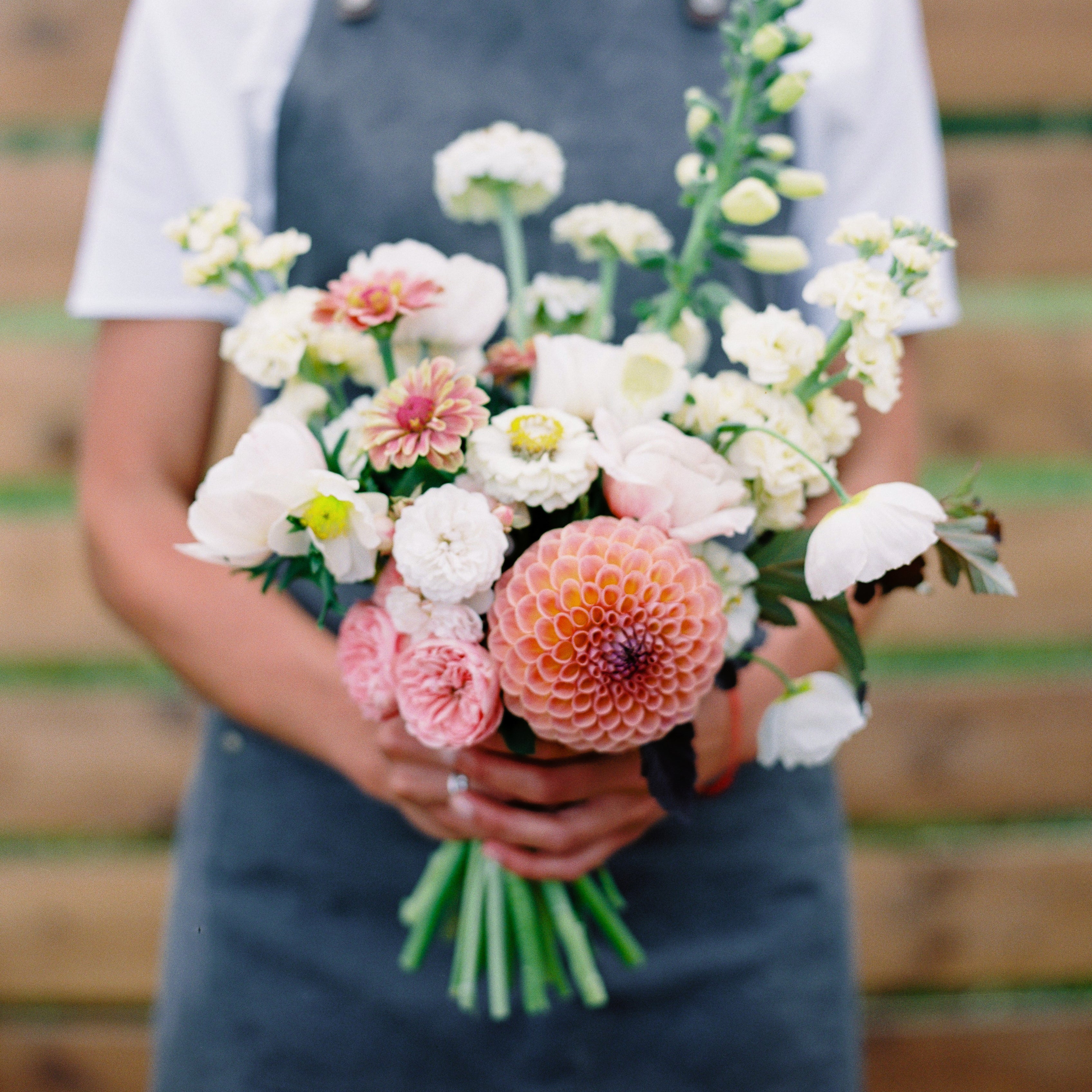
Kristine has explained that she deliberately breeds for both markets. She has a particular affection for soft peaches, pinks and whites, while also experimenting with oranges and more complex color combinations. These softer, nuanced colors have become one of the recognizable characteristics of many KA’s® dahlias.
Instead of simply breeding the biggest or brightest possible flower, she asks a different question:
Would a florist want to put this flower in a bouquet?
That philosophy has produced dahlias with sophisticated colors, unusual transitions and forms that work beautifully in floral design. At the same time, many of her introductions have received major recognition in the American Dahlia Society.

The making of a new dahlia
Creating a new cultivar can begin with something as simple as deciding that two particular flowers would look beautiful together. But turning that idea into a stable variety takes years.
One of Kristine's best-known examples is KA’s® Cloud, created by crossing ‘Elma Elizabeth’ with ‘Kenora Jubilee’. For a controlled cross, the flowers need to be protected from insects. Kristine has described covering developing blooms with fine netting, waiting for pollen to become available, and then transferring pollen from one parent to the other by hand. The process is repeated, and the developing seed head is protected until the seeds mature.
The timing is important. Kristine has explained that she generally performs her hand pollination in late August and early September, after the coastal fog has dried from the flowers. That leaves a limited window before autumn rain makes seed collection difficult. Once the seeds are harvested, the real waiting begins.

A flower is only the beginning
The next season, the seeds are germinated. Each seed becomes a new plant. And each plant is a genetic experiment.
Kristine has described growing hundreds of seedlings and then selecting only a small percentage to continue into the following year. More recent accounts of her breeding work describe an even larger scale, with roughly 1,500 seedlings being evaluated and only around 50 carried forward. The process becomes a constant exercise in elimination.
A breeder might walk through hundreds of plants looking for one particular combination:
the right color,
the right form,
a strong stem,
good plant habit,
productive flowering,
and something that makes the flower different from everything already on the market.
Sometimes the most exciting seedling is not the most perfect one. A little irregularity, an unexpected color or an unusual petal arrangement can become the beginning of something new.
KA’s® Cloud and the recognition of a breeder
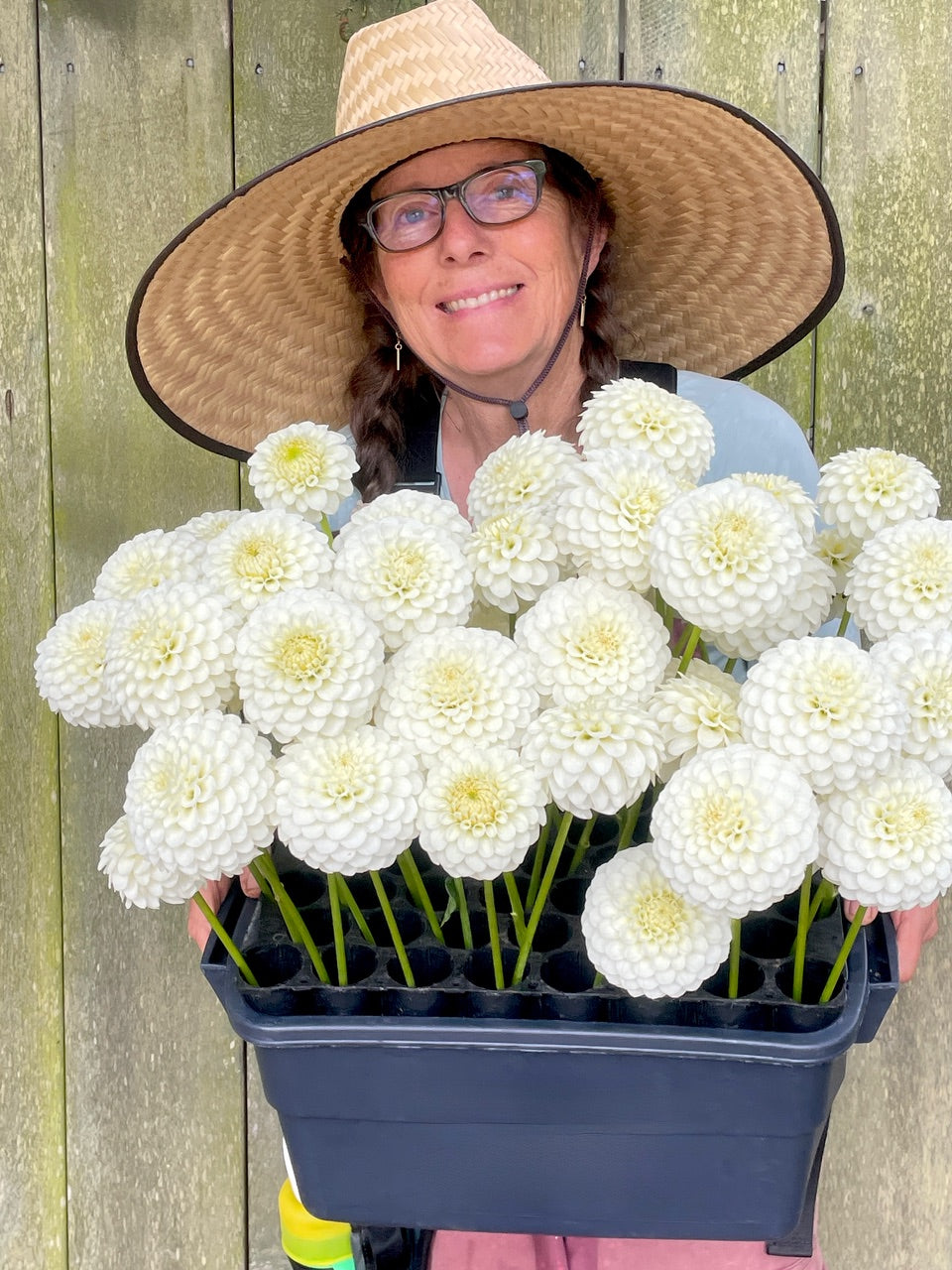
KA’s® Cloud is perhaps the cultivar that first brought Kristine's breeding work to a much wider audience. The enormous soft pink and white flowers attracted the attention of flower farmers and designers, including Erin Benzakein of Floret, who wrote about discovering the variety and becoming fascinated by its colour, size and long stems. But KA’s® Cloud was also highly successful in the exhibition world.
Kristine's official website records major awards for the cultivar, including the Derrill Hart Award, the Lynn P. Dudley Award and recognition at the national level.
Other KA’s® introductions followed.
KA’s® Khaleesi, for example, became another major success and received the prestigious Stanley Johnson Medal in 2023. According to Santa Cruz Dahlias, this was the first time the award had been won by a California breeder. In 2024, KA’s® Khaleesi also received the Les Connell Medal.
These awards are particularly significant because they show that breeding for florists and breeding for exhibition do not have to be mutually exclusive.

The art of looking for something that doesn't exist
Perhaps the most fascinating part of Kristine's work is that she does not simply reproduce successful combinations. She is constantly looking for something new.
In interviews, she has spoken about her interest in colours that are difficult to achieve in dahlias — particularly mocha, brown and complex muted tones. Breeding for colour is unpredictable. A cross between two flowers does not simply produce an intermediate colour. Because of the complex genetics of dahlias, the offspring can display an enormous range of combinations. That unpredictability is precisely what makes seed breeding so exciting.
You can choose the parents. You can make the cross. But you cannot completely control what comes next.
As Kristine has explained, even when she gets close to the colour she wants, she may breed back to a parent or combine siblings in subsequent generations to move the characteristics closer to her goal.
It is a long-term process.
And sometimes a breeder needs to wait several generations before the original idea finally becomes a convincing plant.

Breeding is part science, part observation
Kristine's approach is also a reminder that plant breeding does not always begin in a university laboratory. In interviews, she has openly described her work as being based largely on practical experience. She learned from growing, observing, recording and repeating. She also became involved in the broader scientific community around dahlias, including work connected with the American Dahlia Society's Dahlia Genome Project.
For a crop as genetically complex as the dahlia, this combination of practical breeding and increasing scientific knowledge is particularly exciting. Modern dahlias are genetically complicated plants, and the enormous diversity found among seedlings is one of the reasons breeders can continue discovering new colours and forms.

A breeder, not a tuber producer
There is one more thing that makes Santa Cruz Dahlias unusual : Kristine does not focus on selling her own tubers or cuttings.
Instead, her work is dedicated almost entirely to hybridization. The KA’s® varieties are propagated and sold through a network of licensed growers. This allows Kristine to concentrate on what she does best: creating and evaluating new genetics. The model has allowed KA’s® varieties to travel far beyond Santa Cruz.
Today, licensed growers in different countries help make these genetics available to gardeners and flower farmers around the world.
It is a fascinating model for a modern plant breeder: the breeder concentrates on genetics, while a network of specialist growers handles propagation and distribution.
What makes Kristine Albrecht's dahlias special?
The answer is not simply colour. It is the combination of traits.
A successful KA’s® dahlia can have an unusual color, a beautiful form, a strong stem, good garden performance and enough personality to make it immediately recognizable.
But perhaps the most important characteristic is that these flowers feel different : they don't always look like dahlias bred simply to win a competition. They look like flowers someone would want to put in a vase.
That is the space Kristine has carved out in modern dahlia breeding - somewhere between the exhibition bench, the flower farm and the florist's studio.


Hinterlasse einen Kommentar
Diese Website ist durch hCaptcha geschützt und es gelten die allgemeinen Geschäftsbedingungen und Datenschutzbestimmungen von hCaptcha.